International Track Record
International Track Record
Pioneering international expansion in the construction industry
Today, we operate through an extensive network of offices and locations worldwide.
We have established a strong international presence across various regions, including South America, China, Southeast Asia, India, the Middle East, and Africa.
Drawing on the expertise and experience accumulated through decades of international projects, combined with the advanced technologies and high standards of quality that characterize Japanese general contractors, we have earned strong recognition and the trust of our clients worldwide.
History of Our International Expansion
1960s
Expansion in South America, primarily in Peru
Fujita’s international expansion began in April 1962, when the company dispatched a research mission to South America led by then Executive Vice President Masaaki Fujita. The following year, Fujita was awarded the contract for the design and construction supervision of the Japan Pavilion at the 3rd Pacific International Fair, held in Lima, Peru.
Fujita subsequently undertook various projects commissioned by the Peruvian government, including university facilities and water supply infrastructure. The company also expanded its operations to countries such as Brazil, Ecuador, and Venezuela, where it went on to secure a series of major construction contracts.
1970s
Expansion into Asia-Pacific and the United States
During the 1970s, Fujita expanded its operations into the Asia-Pacific region and the United States. Notable projects included the Hyatt Regency Seoul in Seoul, South Korea, and the Guam International Trade Center on the island of Guam. In the United States, in addition to acquiring and renovating the Miramar Hotel, the company expanded into areas beyond construction, including the acquisition and development of industrial park properties.

Hyatt Regency Seoul (South Korea, 1978)
Expansion into the Middle East and Continued Growth in South America
During the 1970s and 1980s, Fujita significantly expanded its operations in the Middle East. Major projects included the expansion of an oil refinery in Riyadh, Saudi Arabia, and the construction of Seif Palace, the royal palace and central government offices in Kuwait. In Iraq, the company also undertook the construction of a gymnasium and an outdoor stadium in Baghdad.
In South America, Fujita’s operations continued to grow steadily, particularly in Peru. During this period, the company secured a series of major contracts, including civil engineering works for a cement plant in Honduras and the construction of Viru Viru International Airport in Bolivia.
1980s
Expansion into China and International Leadership
Expansion into China and Leadership Among Japanese General Contractors
In the late 1980s, Fujita turned its attention to China as the country embraced economic reform and opening-up. In 1987, the company was awarded the contract for the Xi’an Grand Castle Hotel, followed by projects such as Hengsheng Tower and Shanghai Ganghui Plaza.
In 2003, Fujita established its local subsidiary in China, Fujita China. Since then, the company has built a strong track record and established a leading presence among Japanese general contractors in China.

Xi’an Grand Castle Hotel (China, opened in 1993)
1990s
Accelerating Expansion Across Asia
A partir de la década de 1990, Fujita aceleró su expansión en Asia, más allá de China. Se establecieron sucursales y filiales locales en países como Vietnam, Corea del Sur, Singapur, Malasia y Filipinas, ampliando rápidamente la presencia internacional de Fujita en la región.
2000s
Early Expansion into Mexico
Fujita expanded into Mexico after 2000. Anticipating the growth of the North American automotive industry in Mexico, the company brought together its human resources in the country and established its Mexico Branch in 2004.
This strategy proved successful, and today, automotive facilities are one of Fujita’s key strengths.

Mazda Mexico Vehicle Operation (Mexico, 2014)
2010s
International Development with Daiwa House
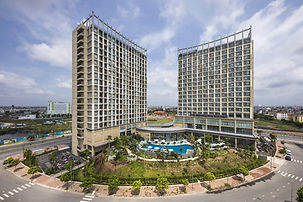
As part of the Daiwa House Group, Fujita has leveraged the group’s synergies to apply its expertise in urban development to international projects, including the construction of large-scale hotel complexes in Hai Phong, Vietnam, and Querétaro, Mexico.